The BGS has developed a new strategy for the period spanning 1 April 2026 to 31 March 2029. To help inform this process, we conducted a survey of our members from 22 April to 23 June 2025 to gather opinions about where we should focus our efforts over this upcoming three-year period. A total of 881 BGS members responded to the survey, equating to a response rate of slightly more than 16%. The following is a summary of the survey’s key findings. A full report and analysis is available to download here.
The respondents
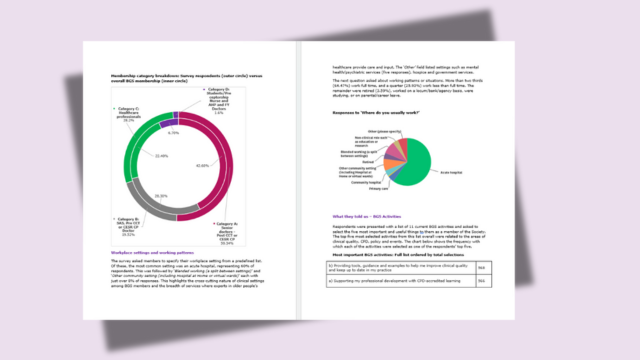
The gender breakdown of respondents (close to two thirds female; one third male) closely matched the distribution across the overall BGS membership, as did the geographical distribution across the four UK nations. In terms of profession, Category A members (senior doctors – post CCT/CESR) were over-represented in responses (50.34% of responses versus 42.6% of members) as were Category C members (healthcare professionals) who account for 28.3% of responses but 22.4% of the membership. The remaining categories were therefore moderately under-represented. More than half of the respondents worked in acute settings (60%), and 8% in community settings. More than two thirds (64.47%) work full time, and a quarter (25.93%) work less than full time.
Members’ thoughts about current BGS activities
Respondents were presented with a list of 11 current BGS activities and asked to select the five most important and useful things to them as a member of the Society. They were then invited to rank the five activities selected in the previous answer in order of importance. The following areas emerged as the most important and useful:
- Supporting my professional development with CPD-accredited learning
- Providing tools, guidance and examples to help me improve clinical quality and keep up to date in my practice
- Influencing government and NHS policy on older people’s healthcare across the UK
- Organising meetings, conferences and events for learning, collaboration and information about older people’s healthcare
- Championing a sustainable workforce to deliver care for older people now and in the future
- Supporting and promoting research, including through the BGS journal, Age and Ageing
Members’ thoughts about BGS impact and influence in the future
Respondents were presented with a list of 13 potential areas and asked to pick the five where they believed the BGS could have the most impact and influence going forward. They were then asked to rank these as in the earlier question. CPD, clinical quality, policy influencing, and conferences/events again emerged in the top four. However there was little separating the top 10 areas; free text comments supported this, with many saying they felt many/all were equally important. The list below reflects the overall order of the areas selected by members:
- Strengthening the evidence base on geriatric medicine through the generation, publication and uptake of high-quality research
- Encouraging trainee doctors, nurses and other health professionals to specialise in the healthcare of older people
- Influencing the design of NHS programmes and services at national, regional and local levels
- Advocating for the needs of current and future older people in the reform and planning of NHS services
- Building skills and knowledge of specialists and the wider workforce by developing relevant elearning courses and qualifications
- Delivering topical high-quality national and regional meetings and events
- Improving tools, resources and information about clinical practice associated with older people’s healthcare
- Influencing regional commissioning of frailty-attuned integrated services for older people
- Working with others to reduce avoidable diseases and conditions of older age through prevention/early action programmes
- Campaigning on key issues affecting older people’s healthcare such as a sustainable workforce and better end of life care
- Increasing the public profile and credibility of the BGS, through policy commentary, social media and wider media
- Influencing the understanding of older people’s healthcare by other specialties
- Attracting more healthcare professionals to join the BGS community
Free text themes
In the final section of the survey, members were invited to share free text responses to the question ‘Is there anything else you’d like to tell us about the BGS or its future direction?’ Among these, there were many positive and complimentary comments about the work of BGS and the value of membership. Many comments alluded more generally to issues faced by members, their patients and their services, rather than specifically relating to the role of BGS as a professional Society; however, it can be inferred that there are reasonable steps BGS could take to help address these issues or support members to overcome them. Themes emerging from these free text comments can be divided broadly into the following areas:
- Out-of-hospital, pre-hospital, community and social care
- Online and in-person conferences, elearning and CPD
- External and international relations
- Inclusive multidisciplinary support
- Guidance, examples and quality
- Policy, influence and advocacy
- Commissioning and service provision
- Visibility, public profile and awareness
- Workforce, training and recruitment
Next steps
We would like to thank BGS members for taking the time to share their valued thoughts with us. Members will be kept up to date on the progress of the next BGS Strategic Plan through our regular communications such as FrontPage and AGENDA.