Lucy Aldridge is the Policy Co-Ordinator at the British Geriatrics Society. She posts on X: @LucyAldridge96
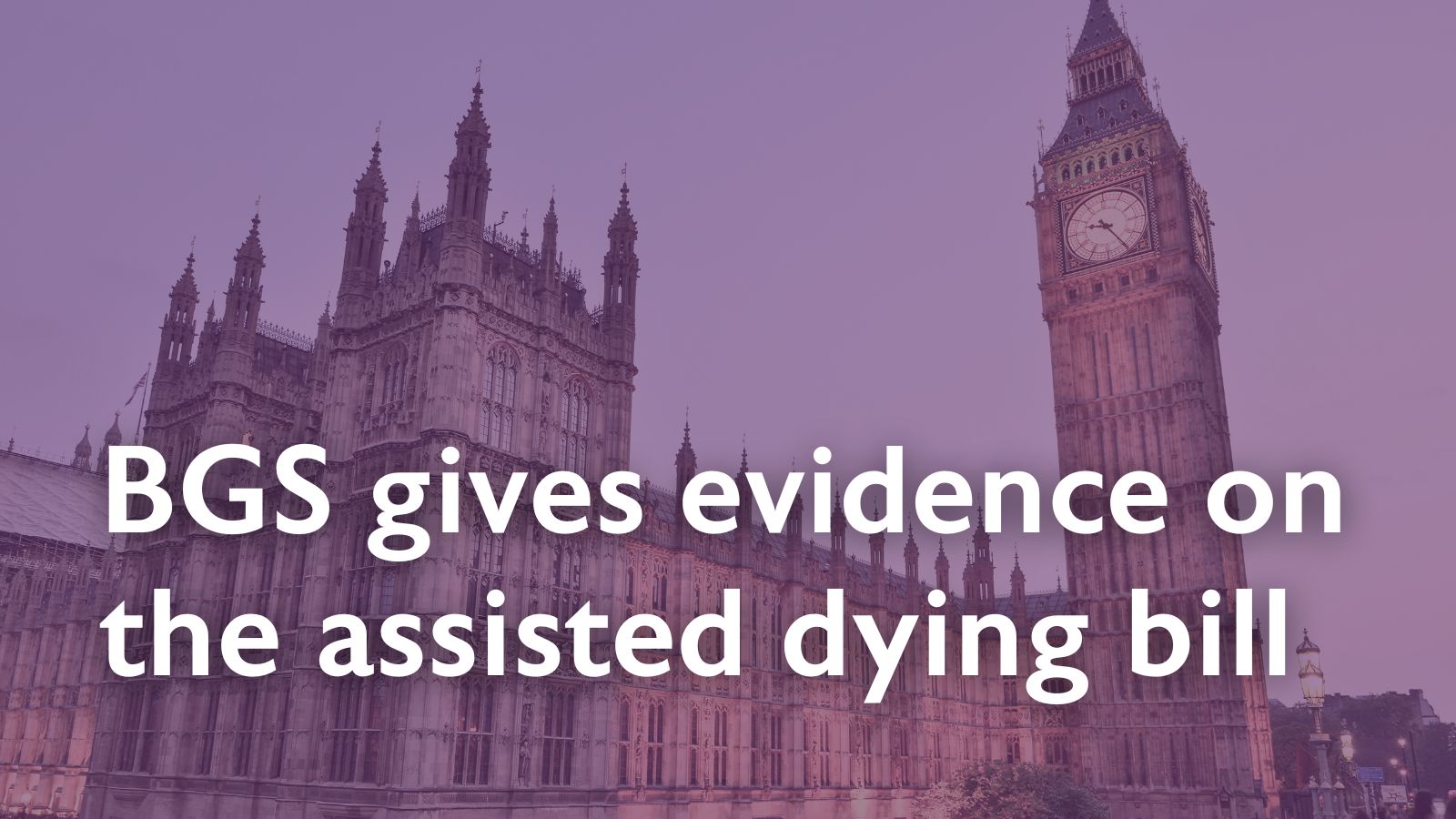
On Wednesday 29 October, Professor Martin Vernon, Chair of the BGS Ethics and Law Special Interest Group (SIG), gave evidence to the Terminally Ill Adults (End of Life) Bill Committee in the House of Lords. This session was broadcast live and is available to watch on the parliament website.
The Terminally Ill Adults (End of Life) Bill Committee was appointed to hear evidence from professional bodies, those with professional experience, and ministers on the safeguards and procedures set out within the bill. It acts as an additional stage in the bill’s progress through the House of Lords, consisting of oral evidence sessions with invited witnesses. The committee will complete its work by 7 November and will publish the evidence it has received. After this, the bill will proceed with the whole House of Lords scrutinising it by debating and voting on amendments.
The BGS was invited to act as a witness in a session focused on safeguards, and particularly the bill’s potential impact on older people. This provided an opportunity to highlight specific concerns with the bill and suggest amendments to make it as safe and workable as possible for older people.
Professor Vernon, lead for assisted dying issues at the BGS, sat on a panel with Caroline Abrahams CBE, Charity Director at Age UK, and Dr Siobhan O’Dwyer, Associate Professor of Social Care at the University of Birmingham. The panel were invited to give opening statements and were then questioned by the committee.
Professor Vernon outlined the BGS’s current opposition to the legalisation of assisted dying on the basis that we are not confident that effective legal safeguards can be developed to protect older people from harm. In addition, palliative and end of life needs are not currently being met. He stated, “This is not, to be clear, a philosophical opposition. It is an opposition based on published evidence derived from experience across the world and real-world clinical experience.”
He also highlighted the huge impact that a change in the law on assisted dying would have on older people: almost 70% of deaths in the UK are in older people, and as international data shows us, older people are the group who use assisted dying services the most in countries where it is already legal.
On the substance of the bill, Professor Vernon emphasised the BGS’s concerns about the lack of safeguards for older people with complex needs, including the absence of a requirement for a holistic assessment. Such an assessment would identify treatable needs that might otherwise influence people to choose an assisted death.
During questioning, Professor Vernon highlighted further concerns with the bill as it stands. He noted there is little in the bill that sets out the training and qualification requirements for the doctors involved in the assisted dying process. The BGS would strongly recommend requiring doctors involved to be trained in holistic multicomponent assessments. He highlighted that this is the cornerstone of good geriatric medicine: “This is what geriatricians do for a living: work with multidisciplinary teams to undertake those assessments and understand the whole picture.”
At a later point, he expanded on this, stressing that it is extremely common to see patients who are in despair about their whole situation and that “full comprehensive assessment looking at all aspects of a person’s physical health, cognitive health, mental health, social setting,[and]economic circumstances” is highly effective at taking someone out of a health crisis. This, paired with excellent palliative care, may reduce someone’s desire to seek an assisted death.
The opportunity to develop a code of practice through regulations within the bill was also emphasised. Professor Vernon noted that “the bill already seeks to protect people with mental health conditions and adults with learning disabilities. There should also be … a code of practice specifically relating to older people as the dominant users of an assisted dying service”. The BGS strongly supports such an amendment.
On the workforce implications of the bill, Lord Winston noted that “there are far too few geriatricians in this country… clearly the involvement of geriatricians in this type of procedure would be relatively useful and robust.” Agreeing, Professor Vernon said, “There is an inadequate supply of designated geriatricians in this country, even though we are training more. The supply is exceeding demand at the moment. Nonetheless, the specialism of geriatric medicine relies on multidisciplinary teams… There are opportunities for the health service to build its own workforce outwards using other professional groups. However, within this bill, there is only reference really to doctors being involved in this, and the care of older people is entirely a multidisciplinary sport.”
On questions around safeguarding older people at risk of abuse, Professor Vernon highlighted that it is extraordinarily difficult for health and social care professionals to detect abuse, particularly financial abuse. Such professionals often find themselves involved at key decision points in older people’s lives, especially when their health is deteriorating, they are worrying about finances and and they may feel they are becoming a burden to their families or friends. Although some safeguards are already in place, the infrastructure to protect older adults is difficult to implement, and much abuse remains hidden.
Professor Vernon stated that safeguarding needs will be greater in “rural, ethnically diverse, and poorer populations, particularly coastal areas. Where there is deprivation, where there is a lack of access to health and social care services, where there is significant cultural and ethnic diversity, those people are not going to age as well as others and may well feel a greater sense of burden.”
Home visits and face to face consultations act as an important safeguard, Professor Vernon noted: “We know from experience during the pandemic that an awful lot happens behind closed doors and assessing somebody remotely, digitally, without a face-to-face assessment, especially if they have complex health and social care needs, is nigh-on impossible. Trying to do so remotely and via digital means is unfeasible.”
On the issue of how well doctors can predict if someone will die in six months, Professor Vernon drew attention to the fact that “we cannot put certainty around prognosis… the six-month life expectancy is particularly problematic”. He explained that doctors are often good at predicting if someone will die within the next few days and if they will survive beyond one year, but the time between is unreliable. When an older person has multiple health conditions, this becomes even more difficult. Doctors tend to overestimate, he said, which presents problems for the implementation of the bill.
Whilst the bill does not apply to people with diminished mental capacity, Professor Vernon remarked that people with early stages of dementia often retain capacity for making decisions about their health and welfare. He highlighted that “a dementia diagnosis may precipitate somebody who does not understand the trajectory of their illness making an early election to have assisted dying in the absence of any foreseeable palliation of their symptoms.”
During final comments, Professor Vernon emphasised the extreme difficulty of introducing safeguards against the negative assumptions in society around the burdensome nature of ageing. He noted: “We have a very negative narrative in this country around ageing as being deleterious and regressive, and there is very little narrative around positive and supportive ageing… There is a danger that some people who are burdened by illness, loss of capability and capacity, loss of social support, loss of connectivity, may feel subtly pressured and coerced into ending their life earlier than they might otherwise have done… There is an opportunity here for us as a country to improve our offers around palliative support and end-of-life care, for sure, but perhaps the bigger opportunity is to improve the quality of ageing better in our society so that we value older people more.”
You can watch the full session here: https://parliamentlive.tv/event/index/793b3c88-11d4-480d-892e-4273a142c32f