This update for our members provides information on the current position and BGS’s work in this area. It covers:
- why and how BGS is engaging in policy and influencing work on social care
- the legal and funding framework for social care and how it plays out in practice
- the charging framework for social care
It also includes some historical context and wider reflections, and the references used provide sources of further reading.
BGS’s engagement in policy and influencing work on social care
The health implications for older people when they are in need of, but not receiving, support with everyday tasks such as washing, dressing, and eating are only too familiar: the increased risks of a health crisis and an unplanned admission to an acute hospital; repeated readmissions, difficulties with discharge from hospital … the interdependencies between social care and health are clear. This is why one of BGS’s strategic objectives in our 2017-20 strategic plan is to, ”Continue to increase our influence with policy makers and policy influencers with respect to health and social care policy for older people across the UK” .
There are few signs of any quick wins which makes it all the more critical that we promote our position on social care as effectively as possible. In summary, our position is that financial investment is urgently needed, and that long term reform of the system is essential – and we explain the health impacts on older people and the work of BGS members that inform our position. We engage with the social care agenda in a range of ways, for example by: submitting and presenting written and oral evidence to consultations and Inquiries, and participating in high level meetings and debates, attending events and engaging with senior opinion-formers and decision-makers such as All Party Parliamentary Groups. We also collaborate with other charities; earlier this year we provided the clinical voice to support media work by the British Red Cross when they published their report, In and Out of Hospital, which looked at repeated admissions and the difference a volunteer can make by accompanying an older person when they are admitted to, and discharged, from hospital.
We were very pleased when, at the end of last year, our President, Dr Eileen Burns, was invited to join the Expert Advisory Group on the Green Paper on Social Care. It is to Eileen and BGS’s credit that Eileen was the only clinician invited to join the group. At the outset expectations of what a Green Paper might deliver were high. Disappointingly the indications now are that even if a Green Paper is published in the autumn (the publication date was put back from ‘before summer recess’), it is likely to be modest in its scope.
In order to shed light on why any reforms of the current system are so challenging I have provided some information on the funding, legal and charging frameworks for social care.
The funding framework
While overall responsibility for delivery of healthcare is national, responsibility for social care is local. This means it is down to individual local authorities to ensure delivery of the care they are legally obliged to provide to disabled and older people.
Unlike health, social care is not universally free of charge and there is no national budget allocation for social care. Funding from central to local government is not ring-fenced for social care. Local authorities’ main sources of funding are from council tax, business rates and their annual spending settlement from central government. From that they have to find the funds for social care for everyone who is entitled to it.
In 2015 the concept of a social care ‘precept’ was introduced which gave local authorities the power to increase council tax by an additional amount if the funds generated by the increase are ‘earmarked’ for social care (note the word ‘earmarked’ which is a much weaker requirement than ring-fencing income).
In practice, this means that local authorities struggle to fund basic social care. The struggle has been exacerbated by an increase in demand and years of cuts in real terms in the funding settlement from central government to local authorities. The consequence for older people is a tightening of the eligibility criteria for accessing social care. If the current model of funding and care remains unchanged, the funding shortfall is predicted to increase to a minimum of £1.5bn by 2020/21 and £6billion by £2030/31
The legal framework
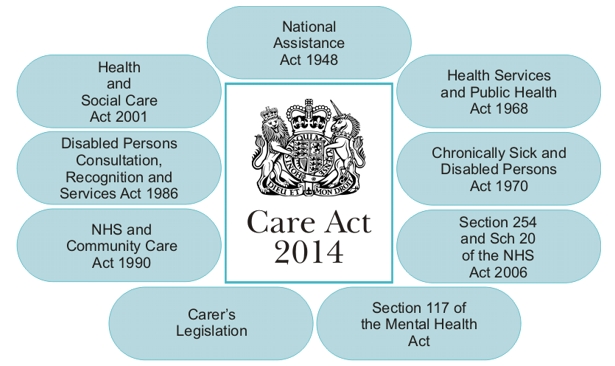
The law that underpins the statutory responsibilities for social care is the Care Act 2014. It was introduced in order to simplify and make fairer the legal entitlements to care and support, which were covered under a number of different pieces of legislation. Its focus is on preventing and delaying needs for care and support. Nine pieces of legislation were replaced by the Care Act (Figure 1).