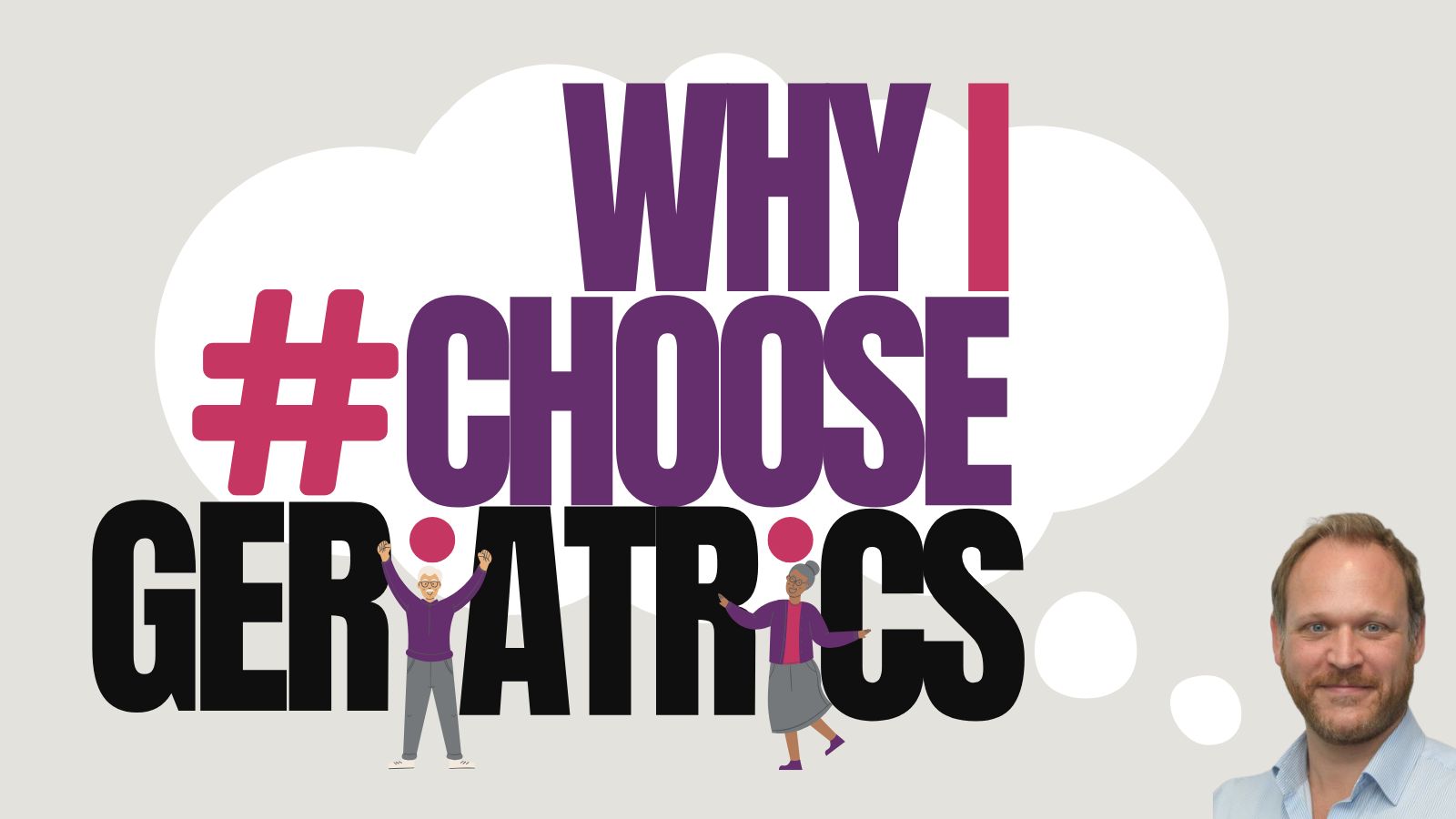
Dr James Adams is the BGS’s recently appointed Frailty Lead. He is a Consultant Geriatrician at the Royal Surrey NHS Foundation Trust.
I have recently taken on the role of BGS Frailty Lead. As I take on this role, and in light of the BGS #ChooseGeriatrics campaign, I have been reflecting on my own journey and career. Why had I chosen to be part of the greatest specialty in modern medicine? Just as with our patients and their complexity, the answers aren’t straight forward and as I pondered the multifactorial reasons, it suddenly struck me – it’s about seeing an opportunity to improve older people’s experience of care, both at the individual and at the strategic level.
This happened to coincide with a conversation with Dr Tom Downes, NHS England’s National Clinical Director for Older People and Person-Centred Integrated Care, who is passionate about the role of patient stories in our work. This can be a powerful tool to help paint a picture of what may be wrong with pathways of care and what may be the ideal. Certainly, with consistent application of key principles in care we can make a big difference in ensuring no-one is left behind. When transforming care through quality improvement, I too am a fan of using the voice of patients to help us understand what is and is not working and to motivate us to craft a new way forward in order to collectively change care for the better.
When I was an SpR in Geriatric Medicine, I had little knowledge of the concept of frailty, certainly nothing like I do now. I was also unaware, even though it was forming the majority of my daily work, that what I was actually part of was a Comprehensive Geriatric Assessment (CGA) approach: working in a multidisciplinary multidimensional way to help our patients, their carers, and their advocates. I was also blind as to its evidence base, and that it was really a golden nugget of an intervention with a very powerful ‘numbers needed to treat.’
Around this time, about 15 years ago, when my grandfather became unwell in his care home, I had little idea he was living with severe frailty, with a Clinical Frailty Score (CFS) score of at least 7. I also had little idea that he was living with at least four frailty syndromes, had unaddressed polypharmacy and multimorbidity. Worst of all, he had no care planning to help capture his wishes or prevent unnecessary interventions and allow a natural death when his time came. Reflecting on the wider systems we had then, we had very few of the alternatives to hospital care that we do now, with frailty teams working in urgent community response (UCR) and Hospital at Home (H@H) services up and down the country and many acute hospitals on a journey towards frailty-attuned services in their emergency floors and same day emergency care (SDEC) units.
My grandfather was admitted to the acute trust, even though this may not have been his wish or even in his best interests. He had no CFS assessment on arrival, no access to frailty multidisciplinary care or CGA. We did, however, make it clear that a pragmatic approach was needed (and not non-invasive ventilation). As he slipped into the terminal phase towards the end of life, my ignorance showed and I got it wrong, insisting that the hospital offered the best place to deliver his palliative care. This wasn’t out of malice of course but genuine lack of knowledge about community care and what often matters most to patients living with frailty. Grandad’s story is now a central feature of our Frailty Academy education and training. There is so much still left to do make sure everyone understands and identifies frailty and knows what to do when they encounter it. There is also much to do in ensuring every older person is able to access evidence-based interventions under the right team, in their own homes or neighbourhood hubs, when preparing for surgery, in urgent care pathways or in hospitals.
And so back to why I chose and continue to choose geriatrics. It wasn’t just because of interesting patients, each with their own story and complexity. It wasn’t just because I wanted to work in multidisciplinary teams and because I viewed myself as a “Generalist.” It was because I wanted to change things for the better. I could see such variation in care for older people, and I wanted to do something about it. I wanted personal growth and to learn new skills in leadership, strategy, and transformation. Geriatrics has given me all of this and more. Being an expert in frailty care is to be the key superspecialist of our time.