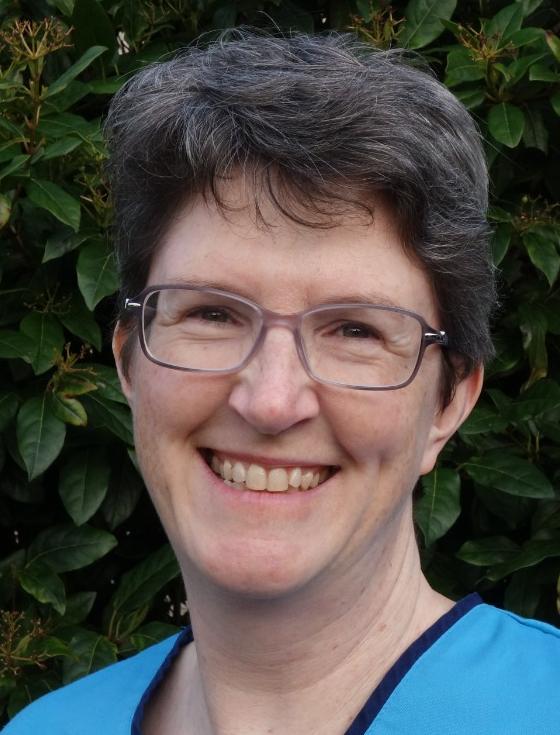
Claire Clark is a Speech and Language Therapist (SLT) in Aberdeen. She is a Care Home Lead SLT, working as part of a dedicated SLT frailty team and is the joint AHP Dementia Lead for NHS Grampian.
I am a Speech and Language Therapist (SLT) in Aberdeen working in a small, single-discipline team which supports older people with living with advanced frailty at home and in care settings. The service aims to support discharges, prevent admissions and care for people at the end of their lives.
I qualified in 1999 from the University of Reading, moving to Aberdeen after my degree. I have worked in acute hospitals, inpatient rehabilitation and outpatients, seeing people with both communication and swallowing difficulties. After a period away from paid work when my children were young, I returned to work across both acute and outpatient settings. It was then that I identified a particular interest and enjoyment in working with older people with frailty. I completed a Master’s degree in Dementia Studies and became increasingly passionate about supporting older people to live and die in the way that they want. When a job in the new SLT frailty team was advertised, I jumped at the chance to specialise further.
Our input is holistic. People in the last months, weeks and days of their lives need to be supported to eat and drink in a way that’s comfortable for them whilst meeting their needs. We don’t shy away from being realistic. We facilitate difficult conversations about what matters and advocate for our patients in many ways whether it’s related to reducing polypharmacy, improving oral care, eating their favourite foods or supporting their carers. Realism means acknowledging that they are nearing the end of their life but making sure that what they have left is comfortable.
I love the education part of my role too. Much of our work involves supporting and educating both professional and family carers about eating, drinking, swallowing and communication. Often increasing understanding and having extended conversations about what’s happening and why reduces carer distress, facilitates discussion and enables identification of what’s important. We can then work together to see what’s possible. I frequently provide training in care homes and work closely with the care home nursing teams and dietitians to support them in providing appropriate and person-centred care around eating, drinking, swallowing and nutrition.
My role includes a lot of problem solving and collaborative discussion of risks and benefits to enable people to eat and drink as they want to. Facilitating people to eat fish and chips seems to be a regular part of my job!
I love having the time to listen to people’s stories about their lives and their families. This often helps me to identify their priorities. We are not working with numbers or rooms but with individuals with long lives, joys and sorrows. Supporting them to live their lives to the end is an immense privilege.
One of the benefits of working in geriatrics is the wider multidisciplinary team with an implicit aim of managing symptoms and providing integrated care. I have been inspired by many of the geriatricians I work with who take the time to balance the medical reality with what is important to the person and have gentle but effective conversations with families and patients.
The greatest challenge is that older people rarely have detailed conversations around what they might want at the end of their lives. Some have additional significant cognitive impairment and are unable to advocate for themselves. Discussions are then had with families who are already overwhelmed with information, decisions and care needs.
Our input is often one or two brief sessions to assess, listen, advise and review. These sessions can still have a significant impact reducing concerns and keeping someone comfortable.
We have a small but growing group of SLTs who work in frailty and acute care at home. Frailty is a developing specialism for SLTs. We have had recent articles in the Royal College of Speech and Language Therapy Bulletin and are looking to develop competencies for SLTs working with this caseload. We advise people new to this area to complete the BGS Frailty elearning and learn more about this endlessly developing specialty through BGS publications and CPD opportunities.
#ChooseGeriatrics for the care.
#ChooseGeriatrics for the stories.
#ChooseGeriatrics for the realism.
#ChooseGeriatrics for the problem solving.
#ChooseGeriatrics to do something that matters.