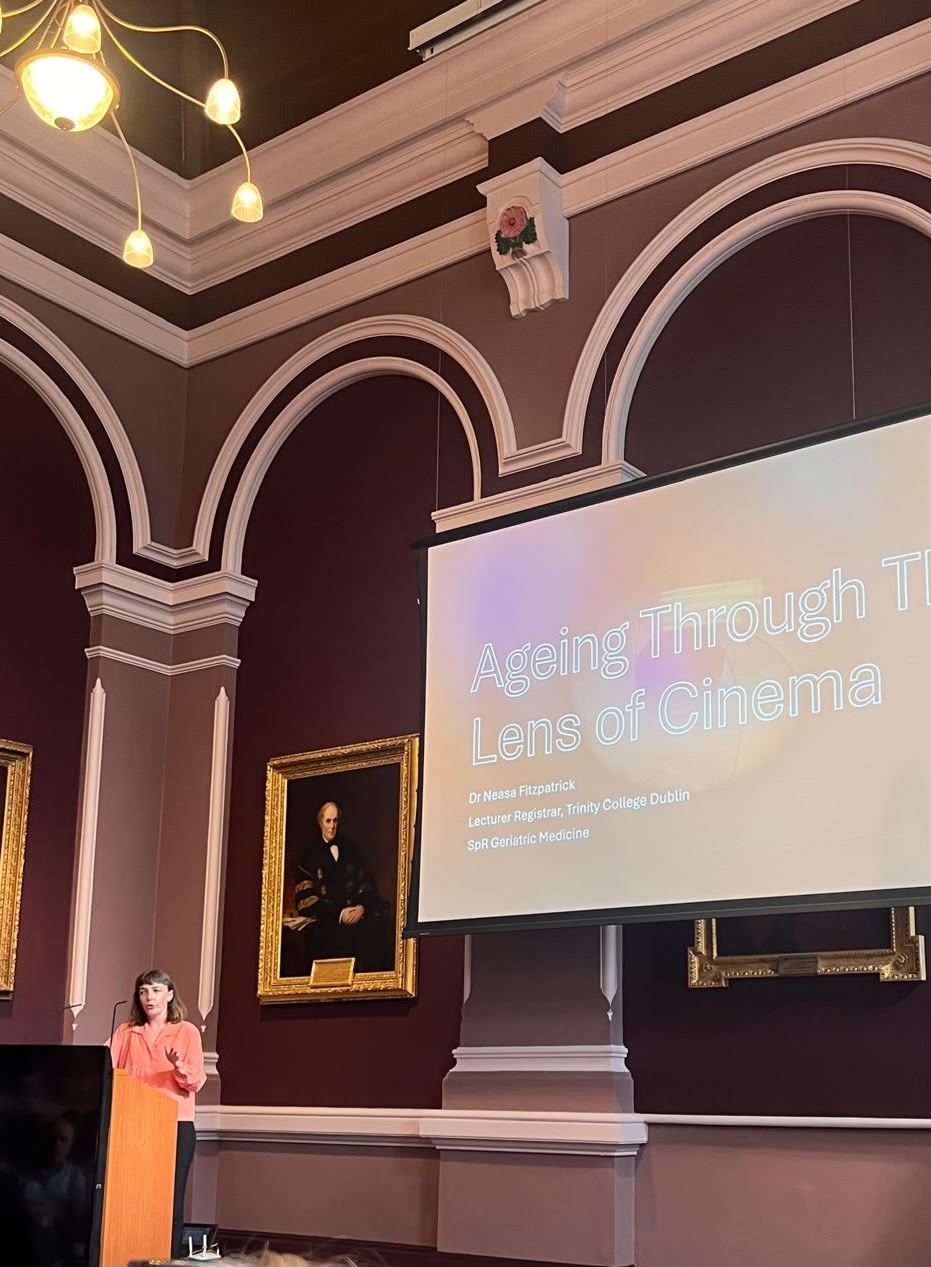
Dr Neasa Fitzpatrick is trainee geriatrician working in Tallaght University Hospital and a clinical lecturer at Trinity College Dublin. She has an interest in healthcare humanities and cultural gerontology and has published several works in this area.
Most literature on the benefits of humanities in medical training is limited to introduction at undergraduate level. This has the advantage of inspiring students’ interest in the humanities early on, as well as utilising co-located university staff from humanities disciplines. However, this focus neglects postgraduate training as a critically important space where humanities-based education could be enormously beneficial1. It is often only after a medical trainee enters the real-world clinical environment that a deeper impulse for meaning-making and critical exploration of their work develops. This group is primed for engagement with the methods of exploration and discovery inherent in the arts and humanities, a lens which expands medicine’s ways of seeing.
Therefore, I was delighted to champion exactly this type of exploration by hosting the first ever formal training day on the topic of ageing in cinema for over forty geriatric medicine trainees in the Royal College of Physicians Ireland entitled Ageing Through the Lens of Cinema. Cinema provides the ideal format for inquiry in such a setting because of its immediacy, its accessibility, its cultural popularity and its shared experience. There were a number of pitfalls that I had observed when reviewing other “cinemeducation” workshops that I wished to avoid. Firstly, the tendency to use film in a perfunctory “trigger” role for wider discussion on an aspect of medicine or clinical experience, without much attention paid to the aesthetic composition of the film. Secondly, a lack of representation from the field of film studies in these workshops. The mission of the medical humanities is primarily interdisciplinarity, and clinicians alone cannot hope to provide this education without appropriate input from the humanities disciplines.
We were therefore joined on the day by Professor Sian Barber, a film studies professor from Queen’s University Belfast, who introduced the trainees to key concepts of film studies and aesthetic analysis of film, and facilitated breakout discussions in the afternoon. After introductory talks from Professor Barber and three geriatricians with an interest in the humanities and broader fields of gerontology, we screened Alexander Payne’s 2013 festival hit, Nebraska. This stars Bruce Dern as Woody, an older gentleman with cognitive impairment who embarks on a journey to claim a fraudulent sweepstakes win with his middle-aged son David (Will Forte). The film is a warm, droll examination of evolving relationship dynamics as parent and child age, highlighting both the vulnerability and resilience of old age along with the endurance of identity and agency.
Attendees were broken into groups of five for breakout discussions. Question prompts instructed them to focus specifically on the aesthetic construction of the film and the effect this had on the viewer. Later, the groups shared their observations with each other. This led on to a discussion of the wider narrative and themes of the film, particularly as they pertained to ageing phenomena.
We, as facilitators, were immediately struck by the level of engagement from participants, who required very little prompting and emerged with fascinating interpretations. Discussion was buoyant and diverse, with novel insights into the film generated. Participants highlighted how the shooting style, landscape shots and measured editing all had an effect on the visual narrative. Perhaps richest of all were the different perspectives on what the film was about. “Rescuing a moment,” “development of respect,” “the part of your parents’ life that you cannot access” and “everybody has a backstory, a reason they are the way they are” were among the responses I had jotted down in my field notes.
As I got the final list of thematic questions, I found that most of these had already been addressed by the participants through their own discussions. Reflections and insights into the ageing experience were naturally generated by the aesthetic exploration. Once those critical modes of thinking were activated in participants, they were able to broaden their perspectives on phenomena of ageing they may not have considered before.
The workshop was very well received. In-person feedback on the day was warm and enthusiastic. Everyone who supplied written feedback agreed that the workshop had helped them understand age-related concepts and that they would recommend the use of cinema in seminars about ageing. Participants reported expanded insights into identity and dignity in ageing, the hidden depths of the ageing experience, and the nuanced family ties that underpin care relationships, as well as overall consideration of the representation of ageing in cinema.
There has been an increasing profile of geriatric medical humanities in our professional discourse, with dedicated sections in journals such as European Geriatric Medicine and JAGS. The success of this workshop encourages me to think that specialist training in geriatric medicine worldwide can develop a more substantive and permanent place in postgraduate specialist training for better understanding of ageing through curated use of arts and humanities.