Geriatricians are doctors on the geriatric medicine specialty register who have trained extensively in the care of older people.
They form part of the highly skilled multidisciplinary team caring for older people and are experts in frailty, multimorbidity and end of life care, among many other areas. They work across care settings, including acute care, community care, primary care and care homes, and may hold roles in research, teaching or leadership.
There are several pathways to become a geriatrician in the UK, and numerous options for career progression and specialisation within all of these pathways, as well as the opportunity to train or work less than full time (LTFT) at each stage. This page sets out some of the most common routes to becoming a geriatrician in the UK.
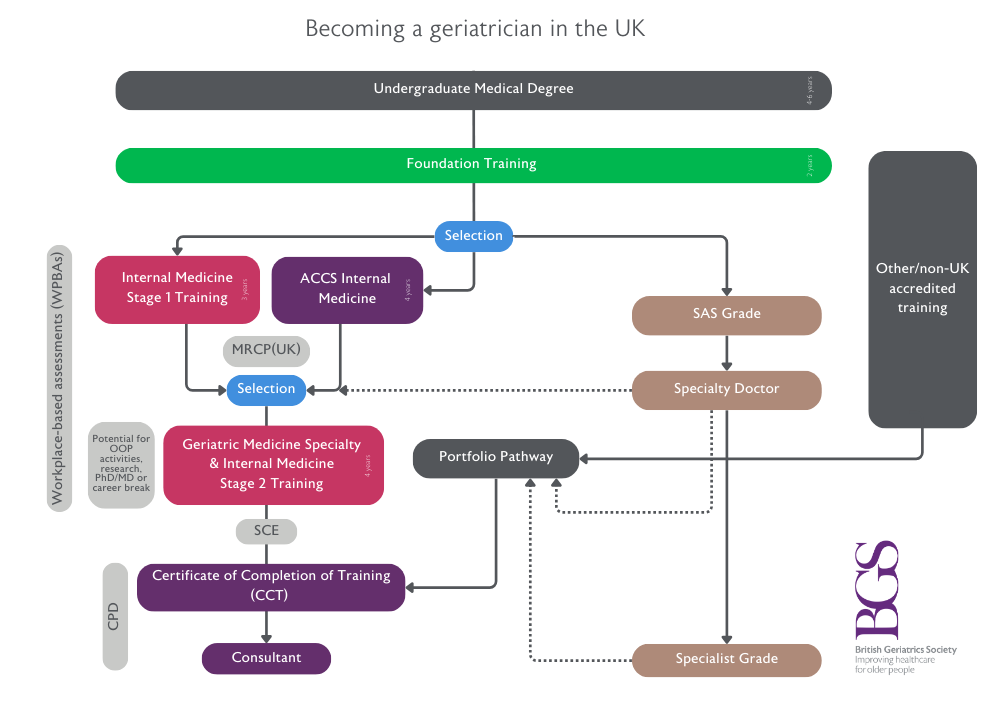
Medical school
Undergraduate medical degree (4-6 years)
This is the first stage of any medical training, usually known as Bachelor of Medicine and Bachelor of Surgery (MBBS). Some courses offer optional intercalated degrees during which you can explore specific interests, such as research, dementia or gerontology to strengthen your knowledge in fields relevant to geriatrics and care of older adults. The MBBS is a primary medical qualification which enables you to register provisionally with the General Medical Council (GMC) and progress to further training.
Foundation Training (2 years)
Foundation Training is a compulsory two-year programme (Foundation Year 1 - FY1, and Foundation Year 2 - FY2) for newly qualified doctors, who might be known as Resident Doctors from this stage. During Foundation Training, you will rotate between medical specialties, which may include time spent in a Geriatric Medicine unit. You will also gain skills and experience working in different acute and community settings. After completion of FY training, you will decide how to progress, but you do not need to choose a specialty at this stage.
Route 1: Medical training route
Core training
Option A: Internal Medicine Stage 1 Training (3 years)
Internal Medicine Training (IMT) Stage 1 training is a three-year programme for all Group 1 specialties, which include Geriatric Medicine. During IMT 1-3, you will again rotate through different core medical specialties, which include Geriatric Medicine, Critical Care Medicine, Outpatients/Ambulatory Care and Acute Unselected Take. Assessment is via workplace-based assessments (WPBAs), Supervised Learning Events (SLEs), and an Annual Review of Competence Progression (ARCP). In IMT3 and above, doctors are known as Registrars. Trainees must pass the full MRCP(UK) and meet all curriculum requirements before the end of IM3 to progress to Geriatric Medicine Specialty Training.
Option B: ACCS Internal Medicine (4 years)
Acute Care Common Stem – Internal Medicine (ACCS-IM) is a less common route for Geriatric Medicine trainees but is another route into higher specialty training. The focus is on patients with acute illness, offering insight into complex multisystem issues. In years 1 and 2, ACCS trainees will rotate between specialties including Emergency Medicine, Internal Medicine, Anaesthetics and Intensive Care Medicine. In year 3 and 4, training continues within a chosen specialty. By the end of ACCS, you must pass MRCP(UK) to progress to Geriatric Medicine Specialty Training.
Higher specialty training
Geriatric Medicine Specialty and Internal Medicine Stage 2 Training (4+ years)
This is the start of specialty training in Geriatric Medicine and is the final stage of training before Consultant level. Trainees are known as Specialty Registrars (StRs) at this stage, and will dually train within the specialty of Geriatric Medicine and General Internal Medicine, or Geriatric Medicine and Stroke Medicine. During this stage of training, there is the potential to take time out of programme (OOP) to pursue other interests such as leadership, research, PhD study, personal career break, etc. It is also possible to train less than full-time (LTFT). At the end of higher specialty training, trainees must pass the SCE (Specialty Certificate of Education), to be issued with a Certificate of Completion of Training (CCT) and be eligible to join the GMC Specialist Register and apply for Consultant posts.
Route 2: Non-training route/SAS grade
SAS Grade
The SAS grade encompasses Specialty Doctors, Specialist Grade Doctors, and other legacy grades that still exist but have since been superseded. This page contains useful information for SAS Grade doctors, and our SAS Grade Group page can be found here.
Specialty Doctor
Specialty Doctors have completed Foundation training and have chosen to continue to gain experience by working as a clinician in a chosen role without the need for regular rotations. They will have at least 4 years of postgraduate medical experience and at least 2 years of specialty experience, and while there is plenty of scope for progression, there is no automatic progression to more senior roles. This can be a fulfilling career option for those who want to focus their experience in a specific area and would prefer stability and choice in where they work. To move up to Specialist Grade, skills and experience must be evidenced through work-based assessments and must meet the Generic Capabilities Framework. It is also possible to switch to a consultant route via the Portfolio Pathway.
Specialist Grade
This is a senior non-consultant role that reflects the experience and expertise of an SAS grade doctor with at least 12 years (10 in Scotland) of postgraduate medical experience and 6 years of specialty experience. Specialist Grade doctors are the most senior clinical grade, reflecting their level of experience within their specialty.
Route 3: Portfolio pathway (formerly known as CESR route)
Portfolio pathway
This is the entry point for those who have completed non-UK-accredited training, or who have progressed through a non-training route such as the SAS pathway. Doctors must demonstrate that they have the Knowledge, Skills, and Experience (KSEs) required to practise as an eligible specialist in the UK. The BGS has a page dedicated to the Portfolio Pathway here.