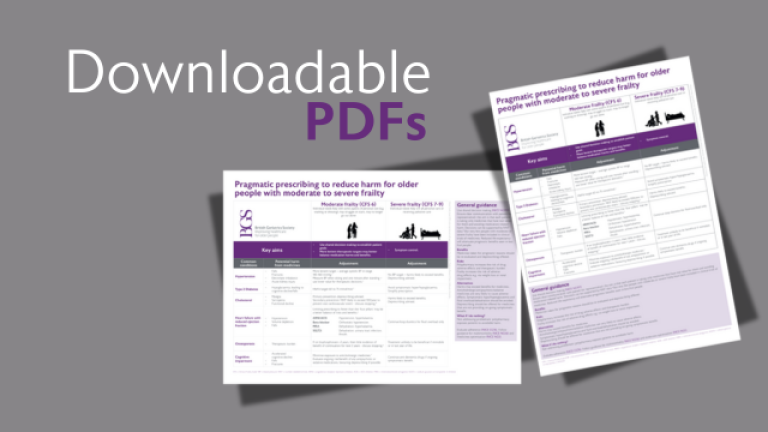
We thank the British Society for Heart Failure (BSH) for their comments on the recently published Pragmatic prescribing to reduce harm for older people with moderate to severe frailty endorsed by the British Geriatrics Society.1 We would like to take this opportunity to clarify several potential misconceptions.
Firstly, this guidance is specifically aimed at older people with moderate or severe frailty. This is an important distinction. We do not suggest moderating prescribing practice based on age alone.
The second clarification relates to the clinical trial evidence for older people with frailty. There are several recognised ways to identify frailty in clinical practice, and each have potential advantages and limitations. Clinical trials, including those for heart failure, tend to recruit younger people with fewer co-morbidities than seen in clinical practice.2 This is likely due to trial inclusion/exclusion criteria and the population screened for participation. Several large heart failure trials have retrospectively applied a form of frailty index to their data to stratify participants into more and less frail groups.3 The items chosen in these frailty indices reflect the data that had been gathered for the trial and include a disproportionate number of items relating to cardiometabolic deficits while omitting important indicators of frailty (e.g. falls, cognitive impairment and polypharmacy) that are routinely included in other, validated frailty indices such as the electronic frailty index 2 (eFI2).4 It is thus likely that people defined as more frail by these criteria are simply people with more severe heart failure among a population that would not be classified as frail using validated criteria, such as the Clinical Frailty Scale (CFS) or eFI2.5 As a result, both potential beneficial effects and harms of prescribing these medicines for people with CFS scores of 6 and above remain unknown. Our guidance utilises the CFS because it is validated, extensively used in practice, and can be rapidly calculated for the patient in front of you.
Thirdly, most clinical guidelines aim to standardise care to promote best practice. While this can be beneficial, there is also the risk of moving away from individualised care, especially for people who are not like the clinical trial population. However, our guidance aims to make care more person-centred by focussing on the use of shared decision-making and offering a modified, individualised approach. The aim is to better balance risks and benefits.
Finally, central to our guidance is the desire to limit medication-related harm. Available trial data do not give an accurate representation of the risk of harm, especially for people with frailty, which is a state of increased vulnerability. Available data, not limited to people with frailty, suggest that around a sixth of hospital admissions are related to medicine adverse effects with cardiovascular medicines frequently implicated.6 Failure to acknowledge this risk has the potential to cause net harm with medicine use in our patients.
There are two important areas of agreement with the BSH. The utilisation of non-pharmacological measures, such as exercise, are excellent examples of how people at greater risk of medication-related harm could benefit from individualised care. Also, the BSH call for clinicians to consider each patient individually is right at the heart of our guidance. But this must be applied not by routinely prescribing every possible medicine but rather by sometimes limiting the intensity of pharmacotherapy based on a holistic assessment of potential benefits, burdens and desired outcomes. In the future, clinical trials may give more representative data for people with moderate to severe frailty, but for now we need to acknowledge the limitations of our knowledge and use shared decision-making to help patients achieve their goals.
References
-
Pitkala KH, Strandberg TE. Clinical trials in older people. Age Ageing 2022;51:1–9. doi:10.1093/ageing/afab282
-
Woodford HJ, McKenzie D, Pollock LM. Appropriate management of heart failure in older people with frailty. BMJ 2024:387:e078188. doi:10.1136/bmj-2023-07818
-
Best K, Shuweihdi F, Alvarez JCB, et al. Development and external validation of the electronic frailty index 2 using routine primary care electronic health record data. Age Ageing 2025;54:afaf077. doi:10.1093/ageing/afaf077
-
https://www.dal.ca/sites/gmr/our-tools/clinical-frailty-scale.html
-
Osanlou R, Walker L, Hughes DA, et al. Adverse drug reactions, multimorbidity and polypharmacy: a prospective analysis of 1 month of medical admissions. BMJ Open 2022;12:e055551. doi:10.1136/bmjopen-2021-055551