The original electronic frailty index (eFI) was developed in 2016, derived from routinely collected primary care EHR data, was supported by NHS England and incorporated into UK GP computer systems used by primary care clinicians.1 It identifies populations at risk of frailty and is calculated by the presence or absence of 36 individual factors. Since then, it has been applied to local populations to predict who may be at risk of adverse outcomes in primary care, as a result of frailty. These outcomes are new home care package, serious falls, nursing home admission, and all-cause mortality.
A new version - the eFI2 - was recently developed,2 and the major GP electronic healthcare software companies in England have, or are in the process of, replacing the original eFI with the eFI2 for national implementation.
How the eFI2 has been improved
Although both versions were internally and externally validated, the original eFI had limitations that have been addressed in eFi2, as seen in the table below.
| Original eFI version | New eFI2 |
| Insufficient coverage of some deficits eg mental heath | Following consultations with clinicians, new, broader range of variables included where they were associated with frailty outcomes |
| All deficits weighted equally | Deficits weighted for their contribution to adverse frailty outcomes |
| No time variance included. Historical codes could still contribute to score, even in more acute presentations, leading to potential over-estimation of score | Time limits included for deficits that are potentially acute or where could be a full remission/resolution (e.g. symptom codes, depression) |
| Arbitrary (non-validated) cut-offs to determine mild, moderate and severe frailty were often used | Cut offs for mild, moderate and severe frailty have been validated |
| In validation of eFI outcomes were considered in isolation | A combined outcome of new home care package, serious falls, nursing home admission, and all-cause mortality was used |
Compared to the original eFI, eFI2 has improved performance for predicting frailty related outcomes, with very good calibration and discrimination statistics. For example, the eFI2 had good discrimination in the external validation cohort (C-index = 0.723, 95% CI: 0.721, 0.725) but eFI had moderate discrimination in the external validation cohort (C-index = 0.687, 95% CI: 0.684, 0.689).2
Factors considered in the eFI2
| Alcohol | Cognitive impairment | Fracture | Medication management problems | Peripheral vascular disease | Skin ulcer |
| Activity limitation | COPD | Fragility fracture | Memory concerns | Polypharmacy | Social vulnerability |
| Atrial fibrillation | Dementia | Heart failure | Mobility problems | Requirement for care | Stroke |
| Cancer | Dressing/grooming problems | Housebound | Motor neuron disease | Respiratory disease | Smoking |
| BMI | Environment problems | hypotension syncope | Parkinsonism tremor | Seizures | TIA |
| Palliative care | Falls | Liver problems | Peptic ulcer disease | Self-harm | Weight loss |
How the eFI2 can be used at different patient levels to aid frailty identification
At the practice level:
- Individual practices use the eFI2 to identify potentially frail patients, which may be part of Local Enhanced Services.
- eFI2 can be used to help track deterioration and worsening frailty in patients over time.
At the neighbourhood level:
- PCNs or Neighbourhoods use the eFI2 to help identify cohorts for Integrated Neighbourhood Teams.
- The eFI2 can also be used as part of population health management tools for larger populations to help identify frail patients who attend A&E frequently or are admitted to hospital often.
How to use eFI2 in practice
- Use the eFI2 to screen for people who may be:
- mildly frail (0.09 ≤eFI2 score <0.16),
- moderately frail (0.16 ≤eFI2 score <0.24), or
- severely frail (eFI2 score ≥0.24).
- Follow this by a brief clinical assessment (e.g., Clinical Frailty Scale) to confirm the presence and severity of frailty in the cohort of interest, such as those who are flagged as moderately and severely frail.
- Offer tailored interventions according to severity in patients for whom it may benefit.3
Tailoring interventions according to severity
Holistic assessments with tailored management plans, such as comprehensive geriatric accessements (CGA), include a medical history, physical examination, functional assessment, cognitive assessment, mood screening, social support evaluation and medication review. In primary care, different members of the multi-disciplinary team may undertake different elements of this, such as clinical pharmacists conducting structured medication reviews and social prescribers supporting emotional wellbeing through health coaching. The BGS Comprehensive Geriatric Asssessment (CGA) Hub contains detailed information about how to approach the different domains of CGA across various settings and multidisciplinary roles.
Figure 1: Interventions tailored according to frailty severity following a clinical assessment
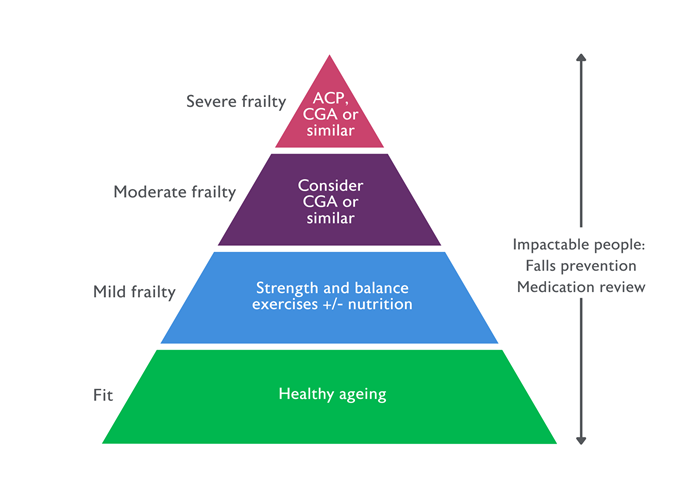
ACP = Advance care planning; CGA or similar holistic assessment and tailored management plan