Dr Somaditya Bandyopadhyay is a consultant geriatrician at Surrey and Sussex Healthcare NHS Trust. He is the SAS Lead for the British Geriatrics Society.
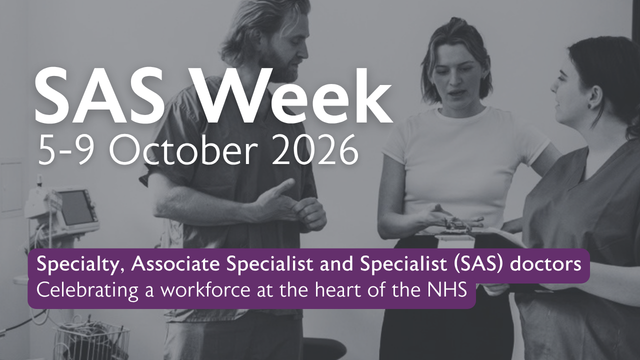
SAS Week 2026, from 5–9 October, provides an opportunity not only to celebrate the contribution of Specialty, Associate Specialist and Specialist (SAS) doctors across the NHS, but also to reflect on how the SAS career is evolving and what more needs to be done to support this important part of the medical workforce.
SAS doctors are central to NHS services, providing experienced clinical care, continuity, education, supervision and increasingly, leadership. Yet significant challenges remain. Pay erosion, contractual differences, inconsistent access to professional development and career progression can limit opportunities for doctors whose experience, expertise and responsibilities may extend well beyond traditional expectations of their grade. For a diverse workforce, including many international medical graduates, concerns about discrimination, workplace culture and inequitable treatment can add further challenges.
At the same time, the SAS career is changing. Increasingly, it is recognised as a rewarding career, offering opportunities to develop specialist expertise, clinical autonomy, education, leadership and service development. Parity of esteem must therefore mean recognising SAS doctors for their contribution, rather than defining them by the career pathway they did not follow. At a time of continuing workforce pressures, recognising, supporting and retaining experienced SAS doctors is essential to the future of NHS patient care.
SAS doctors and the British Geriatrics Society
Over the past five years, the British Geriatrics Society (BGS) has increasingly recognised the importance of supporting SAS doctors working in geriatric medicine. For me, it has also been a journey of learning.
When I took on the role of SAS Lead for the BGS in 2021, I was not entirely sure where to begin. One of the challenges was the sheer diversity of the SAS workforce. Some colleagues were very happy with their careers as they were, while others wanted to progress but did not necessarily see the CESR route as the right pathway for them.
It took me some time to understand that one of the most practical ways the BGS could help was to support colleagues who wanted to pursue specialist registration. We held our first virtual meeting for SAS doctors in 2021, where I met colleagues who had successfully navigated CESR and were willing to share their experience. I then created a WhatsApp group for CESR applicants. That was the beginning of something that has grown considerably since.
As the route to specialist registration has evolved into the Portfolio Pathway, we have continued to develop this support, including a separate group for Portfolio Pathway aspirants. The BGS has also developed resources to help doctors understand the requirements and worked with the GMC on guidance and implementation. Just as importantly, these networks allow colleagues to share experiences and realise that they are not navigating the process alone.
But supporting SAS doctors is about much more than specialist registration.
As SAS Lead, I have also been keen to ensure that the voice of SAS doctors is heard within the BGS and in discussions about the Society's future. SAS representation has now been established within the Education and Training Committee and the Workforce Committee, and we will continue to explore where SAS doctors can contribute to other areas of the Society and influence its work.
The BGS also has an important role in promoting appropriate job planning, clinical autonomy, career development and recognition of SAS doctors. This is particularly relevant in geriatric medicine, where continuity, multidisciplinary working and accumulated clinical experience are central to patient care. Meetings, leadership programmes and educational opportunities provide ways for colleagues to develop professionally and connect across the specialty.
Perhaps most importantly, SAS doctors themselves are an invaluable resource. Those who have navigated specialist registration, career progression, leadership or changes in role can share their experience and help those coming after them. That, ultimately, is what the BGS SAS community is about: creating connections, sharing experience, giving SAS doctors a voice and helping colleagues shape the careers they want.
Looking forward
There has been considerable progress, but there is still more to do. The future of the SAS workforce depends on recognising that SAS doctors are not a single, uniform group. They have different aspirations, career pathways, expertise and professional interests, and the profession needs to create space for that diversity. SAS doctors should have the opportunity to build careers that reflect their experience, skills and ambitions.
If there is one thing I would like to see change, it is a greater willingness among SAS doctors to support one another. I have seen colleagues benefit enormously from the advice, experience and resources shared within the BGS SAS community, and I hope that more of those who have benefited will also feel able to contribute their own experience and support others. We all have a responsibility to give something back. Sharing our experience and helping those coming after us is how a professional community grows. If we want the SAS community to move forward, we need to move forward together.
SAS Week 2026 is a time to celebrate, recognise and look ahead. Let us celebrate what SAS doctors contribute today, support one another, and continue building a profession in which experience, expertise and aspiration are recognised and valued.