Anna Murray is a Senior Programme Manager works for Cheshire and Merseyside Cancer Alliance (CMCA). She currently leads the Frailty in Cancer Programme for the area, with clinical leadership from Mark Johnston, Perioperative Care of Older People undergoing Surgery (POPS) Lead in Liverpool and BGS POPS SIG Co-Chair, and Anthea Cree, Clinical Oncologist at Clatterbridge Cancer Centre and BGS Oncology SIG Co-Chair.
People living with cancer and frailty in Cheshire and Merseyside are set to benefit from a new programme designed to improve the support they receive throughout their cancer care. Underpinned by evidence of the impact on patients living with frailty and cancer, the programme supports NHS providers with a proactive approach to assessment and management of frailty-attuned cancer care. It is closely aligned to other frailty work across the system and complements the national priorities in this area.
At the centre of this work to achieve frailty-attuned care is the vision and mission for the area:
Vision:
For frailty identification, assessment and management to be an integral part of the cancer journey from suspicion through to survivorship and end of life. We will ensure that this enables patients to receive the right support and intervention by the right people, at the right time and in the right place as part of accessing the best care for their needs.
Mission:
To ensure incorporation of frailty screening, assessment and management practices by all providers and health and social care professionals involved in the care of patients with cancer using a whole pathway approach from presentation through to survivorship and end of life. Bringing together stakeholders from across frailty and cancer to take a collaborative, evidence-driven approach to improve patient outcomes and experience.
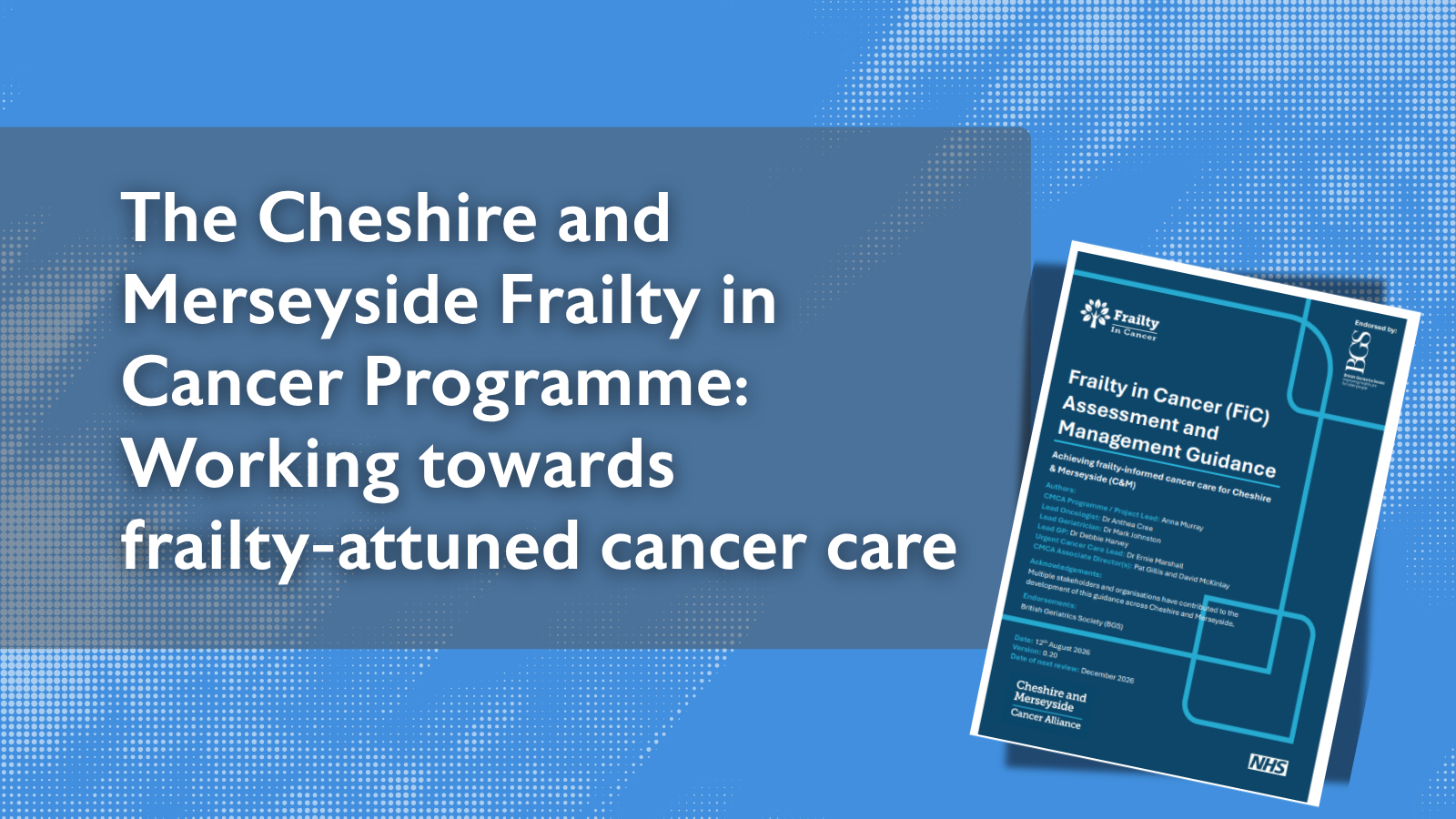
Importantly, these statements are underpinned by the Cheshire and Merseyside Frailty in Cancer Assessment and Management Guidance. The guidance has been developed using a deliberately collaborative approach with input received from across the system in addition to the primary authors identified in the document. The document brings together multiple pieces of guidance into one cohesive document. It takes a pathway approach from presentation through to end of life or survivorship, encouraging proactive screening, assessment and management at key points in a patient’s cancer journey. The aim is to help patients receive the right support and intervention from the right people, at the right time and in the right place, so they can access care that is appropriate for their needs. By identifying frailty earlier and responding to it in a coordinated way, the programme also aims to optimise use of healthcare resources and contribute to national priorities and evidence-based cancer care.
CMCA are now working across organisations to implement this guidance. This work includes key stakeholders from across both frailty and cancer and includes an emphasis on workforce education and training to increase awareness and the capability of staff to screen, assess and manage frailty.
The guidance has been endorsed by the Cheshire and Merseyside Integrated Care Board Clinical Effectiveness Group and the British Geriatrics Society. CMCA is now working with stakeholders from multiple organisations across cancer and frailty services to support implementation over the coming years. The Alliance has also developed a collaboration with AstraZeneca to further support the work that is being done and is working as part of the North West Learning Improvement Network (NWLIN).
Jon Hayes, Managing Director at CMCA, said: “For many people living with cancer, their experience and outcomes may vary if they are also living with frailty.
“Working towards and achieving frailty-attuned cancer care will support positive improvements for these patients. The Frailty in Cancer Programme has been launched to support this vision, including having a focus on workforce education and training with the development of the Frailty Champion for Cancer role.”
Jude Adams, Executive Director of Strategy and Transformation at Cheshire and Merseyside Integrated Care Board, said: “Our shared commitment across the Cancer Alliance and ICB Urgent Care Programmes is proving that collaborative leadership can drive meaningful frailty-attuned care improvements, delivering better experiences and outcomes for patients across the system.”
A spokesperson for AstraZeneca said: “This collaboration reflects our belief that meaningful progress against cancer happens when healthcare providers, policymakers and industry work together around a shared goal: improving the lives of patients.
“It is another example of how partnerships are helping us reimagine cancer care today, while bringing us closer to a future where cancer is no longer a cause of death.”
Note: AstraZeneca has had no influence on the development of the Cheshire and Merseyside Frailty in Cancer Programme. This collaboration does not represent an endorsement of AstraZeneca products or services.