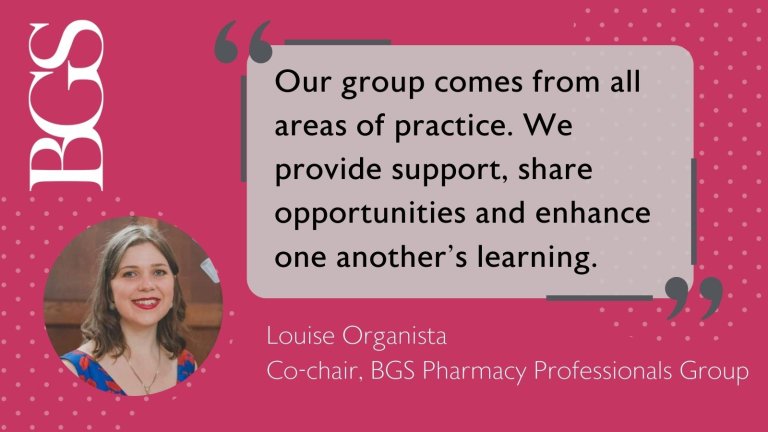
Mina Hunjan and V-Lin Cheong are Co-Chairs of the BGS Pharmacy Professionals Group. Mina is a Clinical Pharmacist in Warwickshire East Primary Care Network. V-Lin is a Consultant Pharmacist for Older People at Leeds Teaching Hospitals NHS Trust.
World Pharmacists Day (25 September) is a moment to celebrate the profession — but this year’s theme, Empowering Pharmacists for Healthier Futures, feels especially meaningful for those of us working with older people. Medicines touch almost every part of ageing, frailty and long-term conditions. When pharmacists are empowered, older people benefit from safer care, clearer conversations and more confident decision-making.
Across the British Geriatrics Society (BGS), pharmacists work in an extraordinary range of settings: care homes, Primary Care Networks (PCNs), general practice, community teams, acute hospitals, specialist frailty services and everything in between. Despite these different environments, our members share a common purpose — improving the lives of older people through thoughtful, person-centred medicines optimisation.
This year, we asked BGS pharmacist members what “empowerment” means to them. Their reflections reveal a profession ready to step forward, stretch its boundaries and lead meaningful change.
A profession moving from tasks to clinical leadership
Many members described empowerment as a shift in identity. Pharmacists are no longer seen — nor see themselves — as simply dispensing medicines or conducting isolated reviews. Instead, they are becoming active clinical decision-makers, fully involved in shaping care for older people.
For many pharmacists specialising in frailty, this shift is driven by both mentorship and science. Members highlighted how they feel deeply empowered by great role models and pioneers in the field, whose leadership has carved out new pathways for advanced practice. Furthermore, the rapid growth of excellent research and evidence-based guidance emerging in frailty provides the clinical foundation pharmacists need to make complex, high-stakes decisions with confidence.
Members spoke about moving beyond traditional medication reviews to taking ownership of medicines optimisation within the Comprehensive Geriatric Assessment (CGA). This includes identifying risks, deprescribing where appropriate, supporting safer transitions of care, and ensuring medicines align with what matters most to the person.
Empowerment, in this sense, is not just about confidence. It requires structural support: education that prepares pharmacists for complex geriatric care, clinical pathways that recognise their expertise, and healthcare strategies that embed pharmacists within multidisciplinary teams.
Integration at the heart of frailty care
Pharmacists across sectors emphasised the importance of being fully integrated into frailty pathways. Whether working in a care home, a PCN, a GP practice or a hospital frailty unit, members highlighted that medicines optimisation is most effective when pharmacists are involved from the beginning — not brought in as an optional extra.
Medication review often becomes the hinge point in frailty care: the moment where risks are identified, burdens reduced and treatment aligned with the person’s goals. Members described how empowerment means being part of the conversation early, working alongside geriatricians, nurses, therapists, social care colleagues and care home staff to deliver holistic care.
Stretching beyond traditional boundaries
Another strong theme was growth. Members talked about empowerment as the ability — and encouragement — to stretch beyond traditional boundaries. This includes leading discussions on polypharmacy, anticholinergic burden, psychotropic use, medicines safety incidents, and the impact of medicines on function and independence.
The horizon looks equally bright as the profession prepares for the onset of a Modern Service Framework. This exciting development represents a major milestone, offering a clear blueprint to standardise, elevate and formalise the vital role that pharmacists specialising in frailty play within multidisciplinary teams.
Pharmacists often spot patterns others may not: a medicine contributing to falls, a treatment burden affecting quality of life, or a prescribing cascade that has quietly escalated. Empowerment means having the support and authority to act on these insights, challenge assumptions and advocate for safer, kinder care.
Person-centred practice at the core
Across all sectors, members emphasised that empowerment is ultimately about person-centred care. Pharmacists want to be equipped and supported to deliver evidence-based medicines optimisation that helps older people live healthier, safer and more independent lives, with consideration for carer roles in medication use.
This includes having the time to talk through medicines, explore goals, weigh up risks and benefits, and ensure decisions reflect what matters most to the person and their family. Empowerment is not only about clinical skill — it’s about being trusted to lead these conversations with compassion and clarity.
A shared vision — and a call to action
Based on these insights, BGS pharmacist members describe empowerment as:
- Clinical leadership in medicines optimisation
- Full integration into frailty and CGA pathways
- Confidence and support to innovate and challenge boundaries
- Person-centred practice grounded in evidence and values
- System-level change that enables pharmacists to thrive across all sectors
This World Pharmacists Day, we celebrate the pharmacists already driving healthier futures for older people — in care homes, PCNs, GP practices, hospitals and community teams. Their work is vital, often quiet, and deeply impactful.
We invite colleagues across disciplines to consider how they can help empower pharmacists further. Whether through shared learning, collaborative practice or simply making space for pharmacists’ expertise, every action contributes to safer, more person-centred care.
From some of our pharmacist members:
Đula Alićehajić-Bečić – Former Co-Chair of the BGS Pharmacy Professionals Group, Consultant Pharmacist Frailty at Wrightington, Wigan and Leigh Teaching Hospitals NHS Foundation Trust
Empowering pharmacists in older people care means expanding their role from simple medicine dispensers to active, patient focused clinical decision-makers within a multidisciplinary healthcare team. We need to move beyond medication reviews to become definitive owners of medicines optimisation within the Comprehensive Geriatric Assessment (CGA). To turn this vision into scalable reality, the profession must shift its focus and deliver structural changes in education, clinical execution and healthcare strategy.
Rosie Marchant, Frailty Pharmacist, North Bristol NHS Trust
To me, being empowered for a healthier future for older people as a pharmacist is being fully integrated into frailty multidisciplinary teams and bringing together stakeholders from across sectors to keep medication review at the centre of holistic care for our ageing population.
Jen Stevenson, Lead Pharmacist for Older Adults, Guy’s and St. Thomas’ NHS Foundation Trust; Honorary Senior Lecturer, King’s College London
Enabling development, engaging in discussion and encouraging to stretch beyond traditional boundaries to provide the best care and improve outcomes for older people.
Heather Smith, Consultant Pharmacist: Older People, Leeds Health and Care Partnership
To me, it means equipping and supporting pharmacists to lead person-centred, evidence-based medicines optimisation that helps older people live healthier, safer and more independent lives focused on what matters to them.