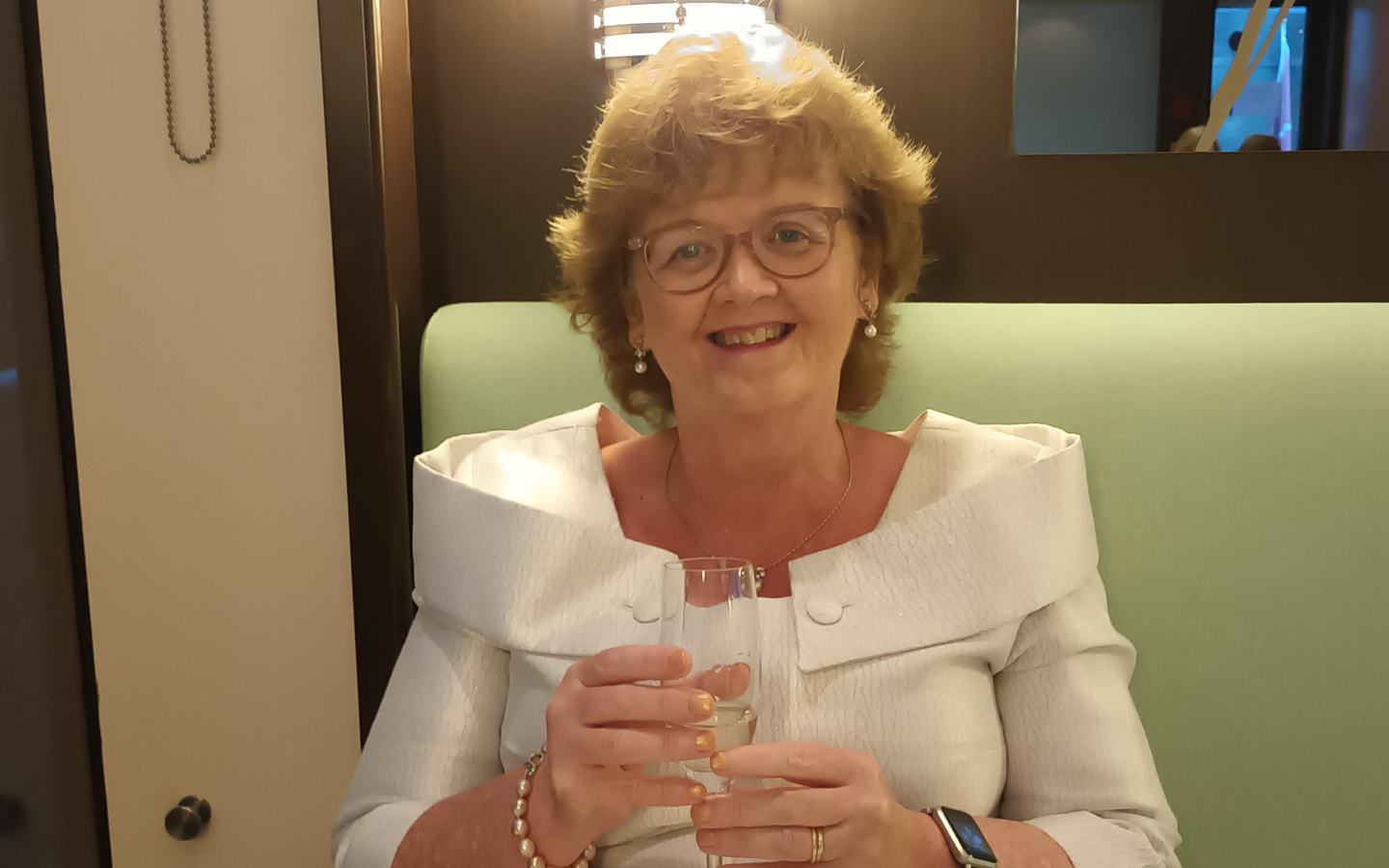
The British Geriatrics Society is delighted to announce that Dr Rhian Morse has been awarded the Society’s prestigious Marjory Warren Lifetime Achievement Award for 2026.
Named in honour of Dr Marjory Warren, one of the founders of modern geriatric medicine, the award is presented annually to an individual who has made an outstanding lifelong contribution to the healthcare of older people.
Rhian’s career has spanned more than 40 years, from her medical training in Cambridge and London to her current role as a Consultant in Geriatric and General Medicine at the University Hospital of Wales (UHW), Cardiff. She has established and delivered a range of services, including intermediate care, rapid assessment, continence and menopause. She has also held numerous leadership positions, including Clinical Director for Geriatrics and Rehabilitation at UHW (2000–2012).
Rhian has made a significant contribution to education and training throughout her career. Her roles have included Chair of the BGS Education and Training Committee (2006–2008) and Training Programme Director for Geriatric Medicine in South Wales (2004–2009; 2020–2025), Specialty Training Committee Chair and Associate Head of School of Medicine.
We spoke to Rhian about her career, what winning the Marjory Warren Lifetime Achievement Award means to her, and her hopes for the future.
What inspired you to choose geriatrics as your specialty, and what inspires you to continue working in geriatrics?
I went into medicine with an open mind and with no preconceived ideas about what I wanted to do. I enjoyed the combination of science and the privilege of talking to people and trying to help them.
During my training, I was drawn into general and acute medicine. I enjoyed being on call and seeing patients of all ages, particularly those with undifferentiated problems, when initially you were unsure as to what was precisely going on, and you worked through a differential diagnosis. These were in retrospect often older people.
It took me some time to discover the specialty of geriatric medicine. I initially had no idea what it encompassed. It wasn't promoted during undergraduate or early postgraduate training. In addition, geriatric medicine services were often quite separate from the other hospital medical services and usually located on separate geographical sites and you had little contact as a junior.
It wasn’t until I was a senior house officer (SHO) and trained with a geriatrician, Dr Patrick Murphy, at the Whittington Hospital, that I gained my first real insight into what geriatric medicine could offer. Subsequently, whilst working in neurology in Oxford, I met Professor Sir John Grimley Evans, who was a strong advocate for geriatric medicine and a hugely impressive role model. He advised a further two years of training in various medical specialties to develop my skills as an all-round clinician, before joining the Department of Geratology under his guidance, and undertaking senior registrar training in geriatrics and general medicine.
At this time, geriatric medicine was beginning to be integrated with general medicine and other medical specialties. Beds were being located on acute sites and geriatricians were working alongside other physicians in acute care. Professor Grimley-Evans was a big part of this change in service model, and as a young clinician, this was a challenge I wanted to be a part of. I’d had my eyes opened to the issues faced by older people and I wanted to apply my knowledge and skills to this patient group and also ensure services for older people were on an equal footing with all adult services. My fate was sealed, geriatrics it was!
Following six happy years at Oxford, I then came to Cardiff as a consultant where integration of geriatric medicine was only just beginning. It was an exciting time, and we broke a lot of barriers to integrating services. A big thank you to Dr Dwarak Sastry who spear-headed this. In addition to running a medical firm and several clinics, I was given responsibility for a rehabilitation ward and asked to look at the day hospitals which were under significant threat of closure. The day hospital nursing and therapy staff were hugely experienced and very committed to the care of older people. Following considerable battling and persistence, we achieved expansion of the day hospital model to incorporate rapid access (next day) comprehensive assessment, the continence service and themed days for Parkinson’s disease, stroke, general rehabilitation and falls. It was the beginning of our intermediate care services and the bringing together of overlapping “geriatric giants.” A busy and rewarding time for the Department. That experience demonstrated to me the importance of fighting your corner and justifying why you need certain services.
A lot of your career has focused on continence and one of your roles is as Lead for the Gerontology Continence Service at Cardiff and Vale University Health Board. What drew you to this area of older people's healthcare?
Whilst working at Oxford, I undertook some research into renal function, urine production and ageing with Dr Sebastian Fairweather, particularly looking at reversal of circadian rhythms and nocturnal polyuria. This led me to realising the link with night-time continence problems and the huge challenge this presents. I subsequently visited Professor James Malone-Lee’s service in London for training in bladder assessments as well as time in Boston and UCLA when I undertook a short visiting fellowship to the USA.
Building the Gerontology Continence Service in Cardiff has been one of the most rewarding areas of my work. The aim is holistic assessment which includes the assessment of co-morbidities and medications. Incontinence has major health implications; it is highly prevalent but paradoxically we often do not address it. Relatively small improvements in incontinence episodes or reduction in night-time voids can hugely impact health, quality of life and can avoid/delay transition to long-term care.
You’ve done a lot of work to support resident doctors and medical students, especially having been Training Programme Director for Geriatric Medicine in South Wales for a decade. Do you have any particularly rewarding stories from that?
I’ve been involved in training for over 25 years - Training Programme Director, Chair of the Specialty Training Committee for Geriatric Medicine in Wales and Associate Head of School of Medicine (previous Wales Deanery).
Over the years, I’ve kept the names of all the registrars I’ve had contact with through the training programmes - over 200!
The most satisfying aspect is just guiding and helping young doctors navigate training (and sometimes life) and supporting their development into consultants who deliver good care, and who advocate for older people and the services required. Instilling a curiosity and a love for the specialty is all important.
I’ve also been involved with the BGS from a UK and Wales perspective from early in my career. I chaired the BGS Education and Training Committee from 2006-2008 and have dedicated time to monitoring out consultant workforce in Wales and increasing registrar numbers.
I continue to be involved in the Specialist Certificate Examination (SCE) for the specialty which I thoroughly enjoy.
It has been such a pleasure and inspiration meeting other geriatricians who are dedicated to training from across Wales and the UK. Some good friendships made!
You've previously had a couple of fun Christmas papers published in the BMJ on doctors' choice of motor vehicle and knowledge of different types of chocolate according to specialty. Why is it important to showcase this more human and lighter side to medicine?
Those were early in my career! I may add that the Christmas BMJ papers do still have to be written as proper scientific articles with appropriate methodology and statistical analyses! It’s a good way for trainees to get experience of carrying out a research project.
I do think it’s very important to have some fun and enjoy the lighter aspects of working in medicine. Part of the attraction to me as a junior was the camaraderie and bonhomie with peers and within teams - laughter is important. You can still be very serious about your work in a friendly environment!
How did you feel when you found out you had not only been nominated for this award, but had won it?
I would say very surprised, humbled and hugely honoured. It’s lovely to be recognised in this way. Thank you BGS.
I’m in the twilight years of my career now and it’s offered an opportunity to reflect on working life – successes and failures! I’m fortunate to have worked with some very inspiring and collaborative people along the way. A particular shout out to colleagues across all professional groups in our department in Cardiff and to others across Wales and the UK who have been and continue to be a joy to work with.
What are you looking forward to in both your career and the specialty more generally?
I have moved to less than full time this year and continue to enjoy working in our continence service. I continue to undertake general medicine/geriatric medicine clinics and menopause clinics (single-handed service for many years). I continue to educationally supervise registrars and enjoy training our registrar cohort as they rotate through the continence service.
I’ve been undertaking some work over the last 18 months looking at continence training for trainees in geriatrics across the UK and identifying geriatricians with an interest, many of whom are single-handed. Training is a mandatory curriculum requirement, yet our survey of regions indicates that continence training provision across the UK is patchy and poorly coordinated. In many locations we have an insufficient number of geriatricians with an interest to develop services and support trainees.
This work is being fed back to the Specialist Advisory Committee in Geriatrics who oversee the curriculum. I have worked closely with Dr Aine McGovern – Chair of the BGS Bladder and Bowel Health SIG in progressing this work.
I presented the data at the BGS Spring Meeting in April 2026, and we are in the process of developing and proposing plans to support better training - meeting again with the SAC in a few weeks’ time. We have developed training guidance - now accessible to all trainees and Programme Directors. In addition, the BGS has developed an excellent elearning package. It’s the development of regional training programmes and face-to-face patient contact and assessments which is now also needed. The possibility of out-of-region training fellowships for trainees with a particular interest and who cannot access this locally is also under consideration.
Therefore, in terms of my plans, I do hope I can continue to move the national continence training agenda forward over the next 12–18 months. I feel positive. There is a sense of momentum with interest from several trainees and newly appointed consultants in tackling this remaining geriatric giant.
Regarding the specialty of geriatrics and the future, personally, there is much to be optimistic about. There have been significant positive changes and developments through my working life, including the emergence of important sub-specialty areas and addressing care of older people within trauma and surgery. However, one area of increasing concern is the care of the older person within the general acute stream (both community/primary care and hospital) where service organisation, constraints, lack of continuity, multiple professional contacts and multiple patient moves across systems is clearly completely contrary to what sick people, with poor physiological reserve, and additional chronic conditions require to recover. There are added concerns regarding the gradual erosion of the interdisciplinary team. I believe Marjory Warren would be encouraging us, despite the challenges, to refocus efforts and highlight concerns to maximise patient recovery and minimise disability. These were clearly stated in her published goals nearly eighty years ago.
Congratulations to Dr Rhian Morse on this well-deserved recognition. We look forward to presenting your award at our Autumn Meeting.