Professor Dawn Skelton is a Professor of Ageing and Health at the Research Centre for Health (ReaCH), Glasgow Caledonian University. She is a member of the BGS Falls and Bone Health SIG Committee.
The last fortnight saw the publication of a position paper from seven international organisations¹ on the need for a coordinated approach to fracture and fall prevention. This joint paper from the European Geriatric Medicine Society, the Fragility Fracture Network, the World Falls Prevention Society, the European Society for Clinical and Economic Aspects of Osteoporosis, Osteoarthritis and Musculoskeletal Diseases, the International Osteoporosis Foundation, the European Union of Medical Specialists – Geriatric Medicine Section, and the International Association of Gerontology and Geriatrics – European Region highlights the critical need for integrated falls and fracture prevention.
This call for integration is not new. Back in 2007, the Scottish Executive released a formal call for this integration within the Delivery Framework for Adult Rehabilitation², followed in 2015 by a call from the Royal College of Physicians’ National Audit of Falls and Bone Health, and the National Falls Prevention Coordination Group’s Consensus Statement in 2017. Yet patients can still be seen in a falls service without having a bone health check, and people can be seen in a fracture service without a falls assessment³. This is seen even within inpatient falls services⁴, where integration, surely, is easier? While we are all still seeing the after-effects of the social restrictions during Covid-19⁵, showing up as more frailty and fractures⁶, it now seems overdue to work on the integration of these services so that people don’t fall through the cracks.
Falls Awareness Week (21–25 September) brings an opportunity to reflect on what’s working well and what needs some work to ensure a seamless, effective pathway to support those both at high risk and those whose activity is currently restricted by concern about falls – who will, of course, become high risk!
We know that concern about falls predicts future falls⁷, and there is a significant gap in clinical practice, with fear of falling not assessed in nearly half of patients presenting with fragility fractures⁸. We know that strength and balance exercise programmes can reduce concern about falls⁹. A multifactorial falls assessment should include fracture risk, and exercise should be aimed at not just reducing falls but also providing the progressive resistance and impact training necessary for bone health¹⁰.
The key is a seamless exercise pathway, with the right programme, for the right person, at the right time. The funding model for falls prevention exercise services is complex and has changed considerably since the Covid-19 pandemic. What were once firmly NHS-based services in the UK, and still are in Ireland¹⁰, have evolved to become dependent on ICBs, Public Health or Social Care in different localities. Multiple charity and leisure providers are now funded to deliver exercise services for those at high risk of falls.
These services are at the mercy of shorter funding cycles and are dependent on local pressures to provide other prevention services. They often do not have strong links back to NHS services and are not commissioned to complete fracture risk assessments, further intensifying this clinical gap.
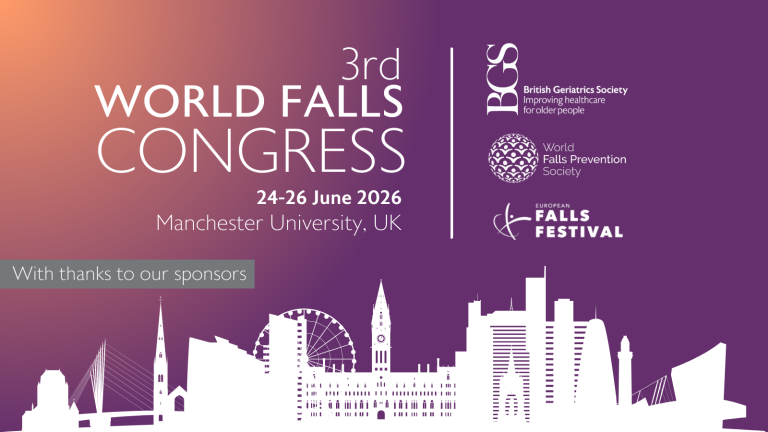
However, there are some fine examples of best practice, highlighted at the World Falls Congress in Manchester in June 2026. I particularly encourage you to consider whether your local falls service only offers three months (or less) of exercise to those at high risk of falls, and whether the exercise programme is evidence-based.
We know, for example, that 24 weeks of Falls Management Exercise (FaME) is needed to significantly reduce concern about falls¹¹,¹², and there is significant variation in how the evidence-based programme is delivered and who referrals come from. Although FaME alone does not increase bone mineral density, it does help maintain it¹³ and does significantly reduce falls rate and risk.
Abstracts at the World Falls Congress show that technology can help support adherence to exercise between face-to-face sessions. If people can access exercise services, this can help reduce social isolation, improve social integration and improve mental health, alongside reducing frailty, falls and fracture risk.
You can still access the content from the World Falls Congress, and I encourage you to immerse yourself for a few hours in innovative ways you can improve outcomes for your patients.
The importance of physical activity, and in particular structured standing exercise for falls prevention, cannot be underestimated, and it’s time we shouted louder for such services to be fully funded and available.
|