Midlands

Region overview

The Midlands region covers the area including:

  • Staffordshire and Stoke on Trent
  • Shropshire and Telford and Wrekin
  • Derbyshire
  • Lincolnshire
  • Nottinghamshire
  • Leicester, Leicestershire and Rutland
  • The Black Country
  • Birmingham and Solihull
  • Coventry and Warwickshire
  • Herefordshire and Worcestershire
  • Northamptonshire

Meet Midlands BGS members

  • BGS members can join our members directory allowing them to connect with other healthcare professionals in their region.
     
  • The forum is free to access for all health professionals with a BGS web account. You can access it via the BGS app. Use the forum to discuss older people's healthcare by theme (e.g. dementia) or topic (e.g. workforce). The forum also allows you to ask questions, or help provide answers to other professionals. It is a forum where health professionals can ask seek help, offer support to others or share their successes. Find out more on the forum information page.

Get involved

There are multiple ways to get involved with your BGS region.

  • Submit content for your regional e-bulletin. The BGS sends a tailored quarterly e-bulletin to each of its six England regions. As the region areas are so vast, you can provide valuable support by sharing updates on what’s happening in your own hospital or Trust. Please email your Co-Chairs with updates.
     
  • Help to plan our online events and webinars. By joining the planning committee, you will have the opportunity to help create programme content, source speakers and support on the day. This will help to enable colleagues to improve the delivery of high-quality healthcare to older people. Please email your region Co-Chairs to express your interest.
Midlands region update June 2026

Our Region Co-Chairs share an update every quarter, highlighting key developments, successes, and priorities from across their region.

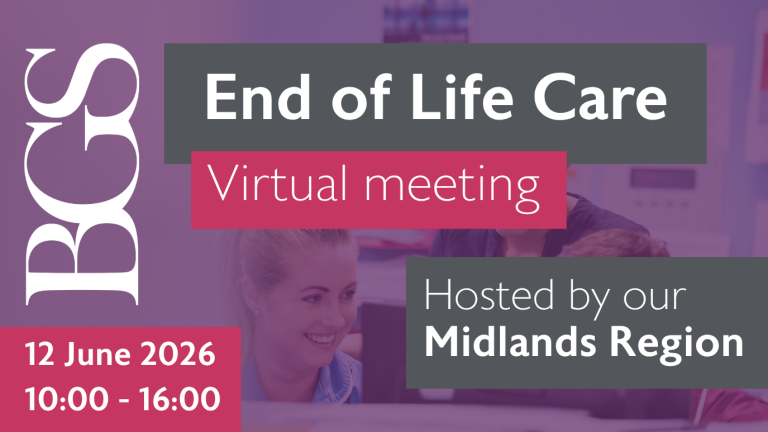
The Midlands Region team is pleased to invite colleagues to our virtual region meeting on 12 June. This year's programme focuses on end of life care and promises a varied and thought provoking agenda relevant to all professionals involved in the care of older people.

The meeting will bring together a range of expert speakers from across the region, covering topics including organ-specific palliative medicine, symptom control, pain management, communication, ethical decision-making and reflective practice. The programme has been designed to offer practical clinical learning alongside opportunities to consider the human aspects of caring for people approaching the end of life. Whether your interest lies in specialist palliative care, frailty, community geriatrics or acute hospital medicine, there will be valuable insights and discussion throughout the day.

We anticipate a highly engaging event and encourage colleagues from across the region and beyond to register. It will be our first as a larger combined region. We’re also delighted with the number of abstracts submitted and the calibre, which make for an interesting read. If you are unable to attend live, on-demand access will be available, allowing participants to benefit from the content at a time that suits them. 

Alongside regional activities, the BGS has continued to publish a range of reports, policy papers and blogs over recent months addressing some of the most pressing issues facing older people's healthcare. Of particular relevance to our meeting theme is the response from 29  April on the fall of the Assisted Dying Bill, outlining “significant concerns that the bill did not contain adequate safeguards to protect older people, the group most likely to be impacted by a change in the law. If a change in the law is considered again, the definition of terminal illness must be tightened, clear safeguards must be included to protect the interests of older people, and the complexities of their needs fully recognised”.

There is also a free-to-members CPD microlearning module on Advance Care Planning and indeed a wealth of other CPD to browse. For more narrative pieces related to the Assisted Dying Bill, there are a series of blogs on ‘where are we now and what happens next’.

Finally, a reflection on recent news regarding accessing medical records. It serves as an important reminder of our professional responsibilities. As doctors, we occupy a privileged position of trust. Access to confidential information is granted solely to support patient care, and maintaining the highest standards of confidentiality, professionalism and respect for patients and their families must remain central to our practice. These events underline the importance of using patient information only when there is a clear and appropriate clinical need and of safeguarding the trust placed in us by those we serve.

Please feel free to contact the Midlands region team if you would like to publicise local initiatives, quality improvement projects, research, education programmes or examples of excellent practice. We are always keen to showcase and celebrate the outstanding work taking place across our region. 

This is the first update since the merger of regions into what is now the Midlands. Reporting regional updates across a larger area is more challenging, so we would like to start by saying hello and inviting colleagues to get in touch with stories of inspirational services or local challenges to feature in this space.

We have a regional meeting planned for 12 June, so please do join us virtually if you can. The programme will be announced in due course, but please do get in touch if you have work you would like to share. Traditionally, these meetings are a great opportunity to come together to celebrate local services, network and hear from colleagues across the region.

Positivity and clear direction feel particularly important at the moment. Across many regions we continue to hear concerns about the persistence of corridor care for older people waiting for beds, which seriously undermines dignity and safety. We would like to draw your attention to the British Geriatrics Society (BGS) response to corridor care from November 2025, which calls for urgent action to restore patient flow and invest in community and social care.

For many geriatricians, ourselves included, witnessing this daily can cause deep moral injury. Locally, solutions have included initiatives such as Same Day Emergency Care (SDEC), geriatrician in-reach to the emergency department, geriatric medicine advice lines and community geriatric medicine services. However, the ongoing challenge of clearly defining geriatric medicine as a specialty within overstretched systems can make service design difficult. As a result, some services are under threat or have already been lost.

Strengthening the identity, workforce and leadership of geriatric medicine is therefore central to the solution. We encourage you to connect with us and engage with regional activities so that we can help highlight and share the important work taking place in your services.