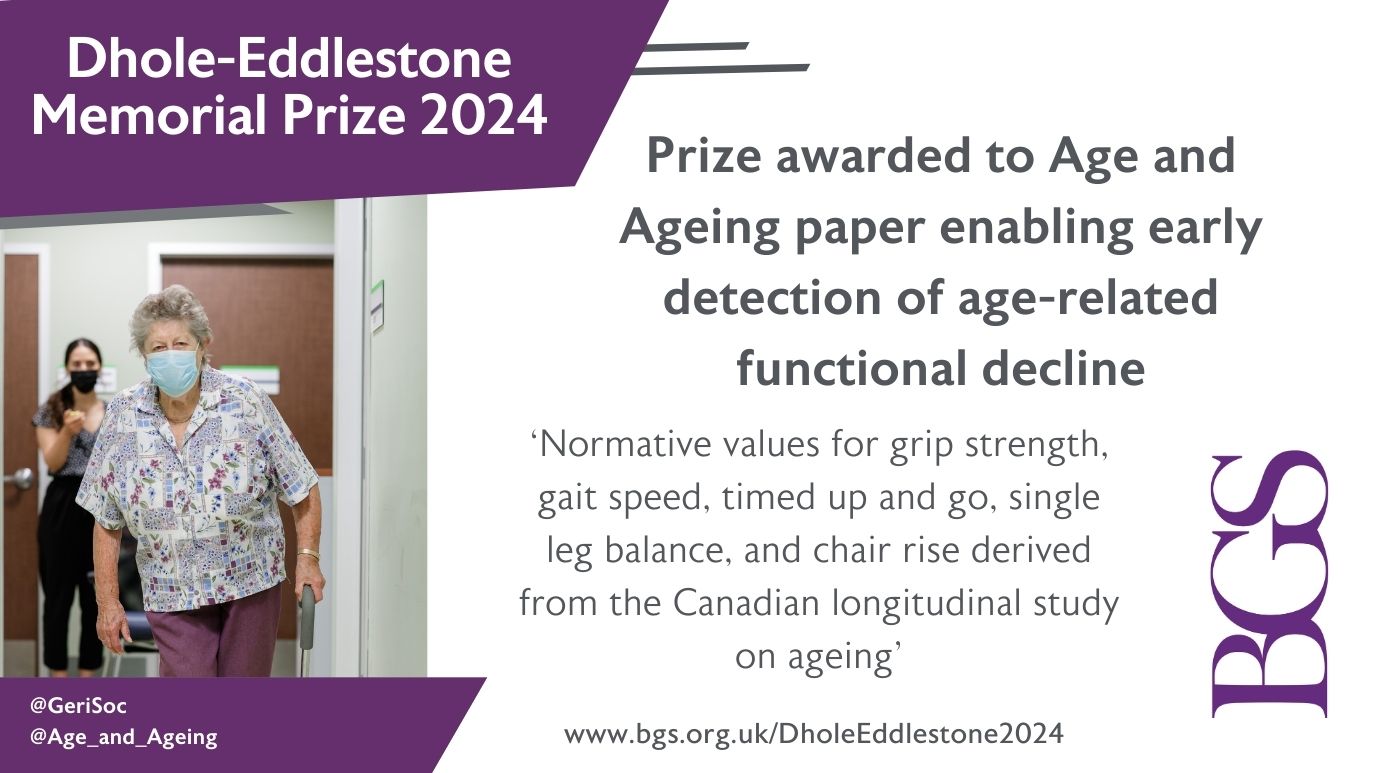
The prestigious Dhole-Eddlestone Memorial Prize has been awarded to an Age and Ageing paper which analyses a major Canadian dataset, the Canadian Longitudinal Study on Aging, to determine normative values for five measures of performance relevant to ageing. The performance charts can, in turn, be used to identify mid- to late-life adults with low physical function relative to their peers of the same age and sex. This prize is given annually to the most deserving medical research relating to the needs of older people, published over the last year in the scientific journal of the British Geriatrics Society (BGS), Age and Ageing.
The Age and Ageing paper, ‘Normative values for grip strength, gait speed, timed up and go, single leg balance, and chair rise derived from the Canadian longitudinal study on ageing’, was published in April 2023. The performance charts developed in this paper were inspired by the World Health Organization’s growth charts for children. The research team identified that the rapid growth experienced by infants and children is analogous to the declines experienced as we age. The performance charts are similar to the child growth charts in the way they benchmark normal performance levels by age and sex. Charts that measure health using key benchmarks are valuable in enabling better targeting of interventions by health professionals.
Retention of physical function and mobility is important for healthy ageing. But even the healthiest people will experience declines in measures such as grip strength and walking speed as they get older. There is a clear benefit to detecting these problems earlier. Older people, and those who care for them, can measure their performance against what is expected for their age and sex, gaining insight to anticipate changes in their care needs. Preventative interventions can change the trajectory of functional decline, preserving mobility and function, and delaying the loss of independence.
The study was led by epidemiologists Alexandra Mayhew and Professor Parminder Raina in the Department of Health Research Methods, Evidence, and Impact at McMaster University and the McMaster Institute for Research on Aging in Ontario, Canada. The research team developed these groundbreaking performance charts to provide an alternative to traditional cut-offs which do not take the expected declines in muscle strength and physical function that occur with normal ageing into consideration. This results in ‘cut-offs’ that over-identify older adults and under-identify younger adults as having low performance. The new performance charts show the distribution of performance in adults aged 45 to 85 years free of mobility impairments for five tests of physical function: grip strength, gait speed, timed up and go, chair rise, and balance.